Footprint, delta, CVD, Volume Profile -- they all show the same thing from different angles: the balance of aggression and passivity.
Two Types of Liquidity
Beginner8 min read
The market has two types of participants, and every volume analysis tool shows the balance between them. Let us examine the full picture -- and see what candlestick charts miss because of it.
Passive and Aggressive Liquidity
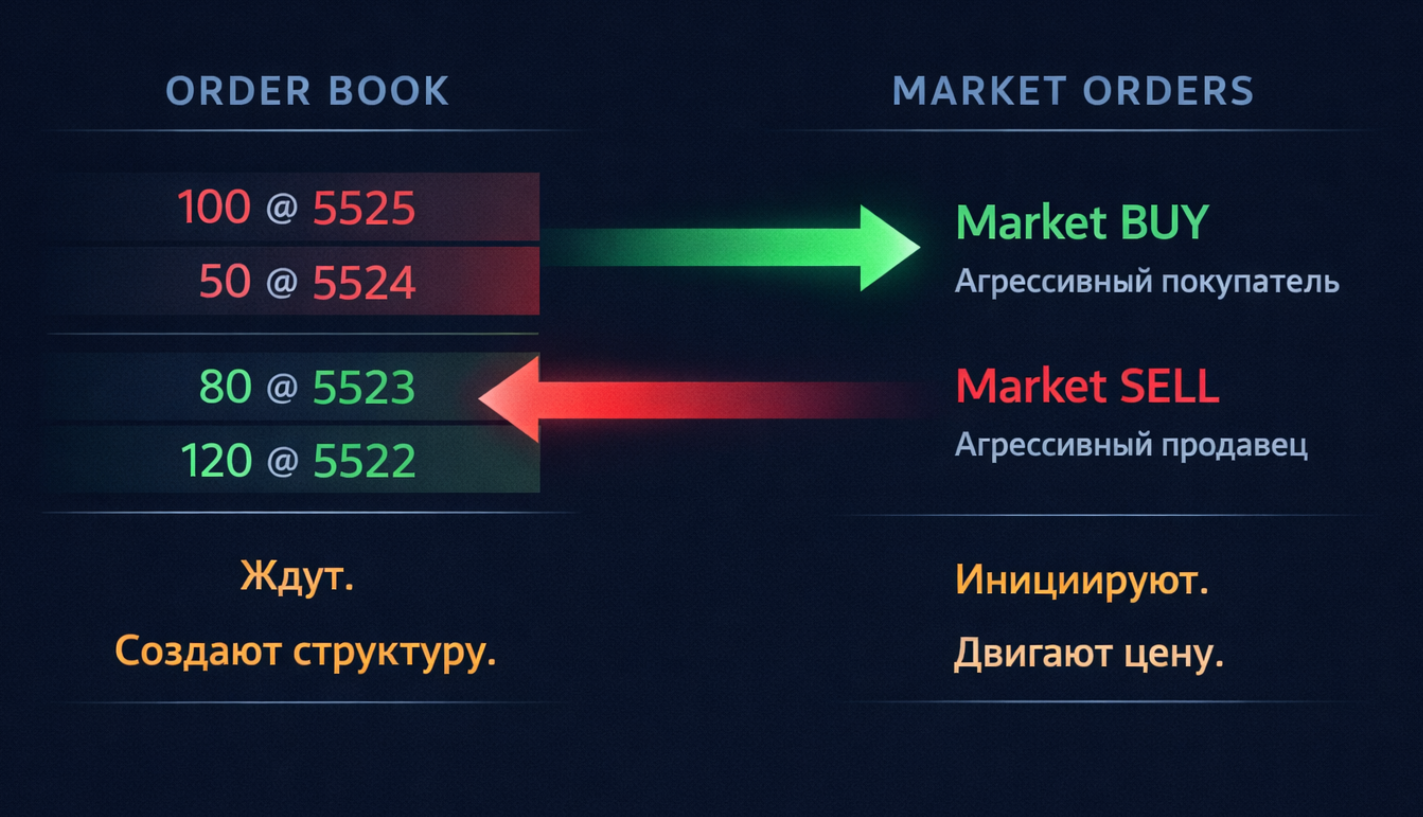
Passive liquidity -- limit orders in the order book. Bid walls, ask walls, levels. They create market structure. Without them, a market order has no one to trade with.
Aggressive liquidity -- market orders (including triggered stops). They consume passive orders and move price. Without aggression, price stands still.
Every trade is a meeting of aggressor and passive participant. For every contract bought, there is one sold. The question is not "who has more" -- buyers and sellers are always equal. The question is who came to whom.
When aggressive buyers hit the ask, trades are recorded on the ask side. When aggressive sellers hit the bid, on the bid side. The footprint shows exactly this: how many contracts at each level were executed on the ask and on the bid. Delta (ask minus bid) shows who is more aggressive.
This Does NOT Mean
"More volume on ask = more buyers" -- no. Volume on the ask side means aggressive buyers hit the prices of passive sellers. For every such trade, there was a seller -- the one standing with a limit order. The difference is not in quantity but in initiative.
High ask volume with rising price -- aggressive buyers overwhelmed limit sellers. High ask volume with falling price -- also happens: buyers hit the ask, but below someone is selling even more aggressively at the bid. Context decides.
"Price fell -- so there were more sellers" -- no. For every trade at the bid, there is a buyer (limit) and a seller (market). They are equal. Price fell because aggressive sellers ate through passive liquidity on the bid.
"The market maker manipulates the market" -- an exaggeration. The MM earns from the spread, not from direction. He does not "move price to hunt stops." Manipulation does exist on exchanges (spoofing, for example), but that involves different participants and is a different story entirely.
From Candle to Footprint
The matching engine connects orders. Aggressors move price. Passive participants create structure. This happens every second.
A standard candlestick chart hides all of this. Four numbers: open, high, low, close. Enough to draw a pattern. But nowhere near enough to understand what happened inside the candle.
A green ES candle, +3 ticks, volume 12,000 contracts. On a regular chart -- a bullish signal.
But let us open the footprint and look at the bid/ask breakdown by level.
Scenario 1. At every level, ask volume is several times larger than bid. Candle totals: 10,000 on ask, 2,000 on bid. Delta +8,000. Aggressive buyers pushed at every tick, sellers offered no resistance. The footprint confirms: this candle is genuinely bullish.
Scenario 2. Ask and bid volumes are nearly equal across levels: 6,500 on ask, 5,500 on bid. Delta +1,000 -- on 12,000 total volume, that is noise. The candle closed green only because a single large market buy came through in the final second. The footprint reveals: not a trend, but a tug-of-war where neither side won.
Scenario 3. Bid volume dominates at every level: 4,000 on ask, 8,000 on bid. Delta -4,000. Twice as many aggressive sells as buys -- yet the candle is green. In the footprint, it is immediately visible: the left column (bid) is heavier than the right (ask) at every price level. For a candlestick trader -- a bullish signal. For someone reading the footprint -- a red flag: price was pushed up on thin ask, while sellers were already building a position.
One candle. Three different footprints. Three different trading decisions.
The mechanics are covered. But how does this help you trade? How do you combine it with what you already know: levels, patterns, trends? Volume analysis does not replace price action -- it is the third dimension that turns a flat picture into a 3D one. In the next module -- the bridge between TA and order flow.
Quiz
1. ES: green candle, +3 ticks, delta = -4,000. What does this mean?
2. "Price fell — there must have been more sellers than buyers." True?
3. What do footprint, delta, CVD, and Volume Profile have in common?
AI Assistant
Two Types of Liquidity
How can I help?
Ask anything about this lesson