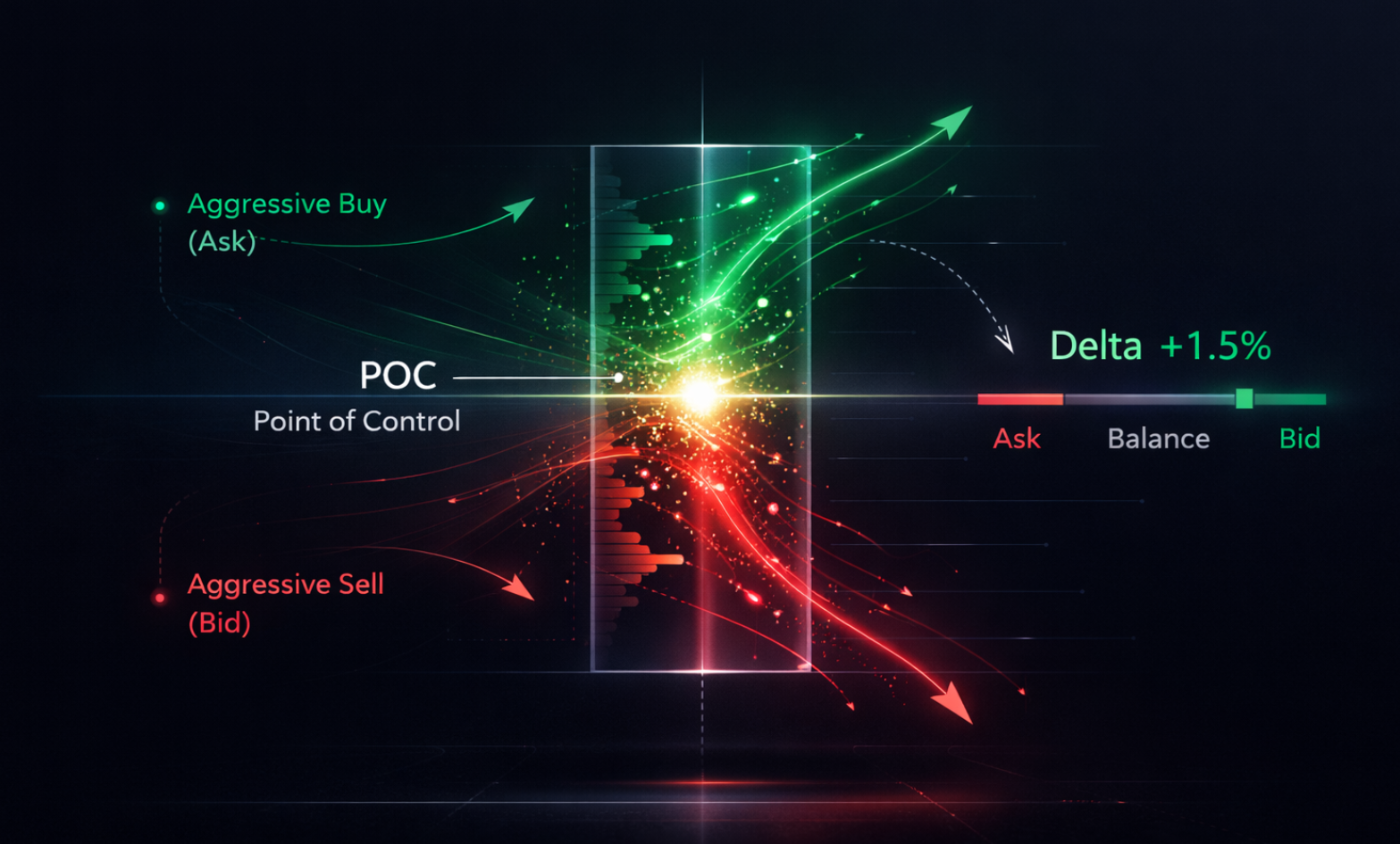
- POC is the gravitational center of the candle — the level with the greatest interest
- Zero on a candle edge = finished auction; non-zero values = unfinished
- Delta = total ask - total bid; delta percent = delta / volume x 100
- Below 5% — balance, 10%+ — initiative, 5-10% — gray zone, look at context
Reading the Footprint and Delta
Beginner8 min read
How to read the footprint
The example from the previous lesson was educational. On a real market, hundreds of orders and thousands of contracts pass through a five-minute ES candle. Here is what the result looks like — a green ES candle, +3 ticks, volume 1,549 contracts:
The first thing we look at is the POC (Point of Control). The level with the highest total volume: bid + ask. Here it is 5525.50: 110 + 295 = 405 contracts. More trades occurred at this price than anywhere else — the market found the greatest interest here. POC is the gravitational center of the candle.
Second — distribution by side. In the upper part of the candle (5525.75-5526.00) ask dominates: 340 + 52 = 392 aggressive buys versus 18 aggressive sells. Buyers were pulling price up. In the lower part (5524.75-5525.00) bid dominates: 310 + 85 = 395 sells, 24 buys. Sellers were pushing down. The middle (5525.50-5525.25) is a battle zone: both sides active, neither winning convincingly.
Third — candle edges. At the high (5526.00): bid = 0. At the low (5524.75): ask = 0. A zero on an edge means price reached that level, tried to go further, found no interest, and reversed. The auction is complete — the market has no further business at that price. But sometimes it goes differently, and we will cover that shortly.
Using these three elements you can read the story of the candle. Green, +3 ticks, looks bullish. The X-ray says: "a draw with a one-goal advantage." Buyers at the top, sellers at the bottom, the result is unconvincing. A candlestick chart would check the "bulls" box. The footprint puts a question mark.
Bar delta
From the footprint we can derive a single number that summarizes the aggression balance for the entire candle.
Delta = total contracts on ask - total contracts on bid.
For our candle:
- Ask: 52 + 340 + 295 + 75 + 24 + 0 = 786
- Bid: 0 + 18 + 110 + 240 + 310 + 85 = 763
- Delta: 786 - 763 = +23
Positive delta — aggressive buys slightly outnumber sells. But +23 out of 1,549 total volume is negligible.
Delta percent = delta / volume x 100 = 23 / 1,549 x 100 = 1.5%.
One and a half percent. A balanced candle: neither side dominates.
Benchmarks:
- Below 5% — balance, a fight with no clear winner.
- 10% and above — initiative, one side is clearly pressing. These candles often start or continue directional moves.
- 5-10% — gray zone, look at context: does delta align with the candle direction, are there imbalances inside.
A single bar's delta is a snapshot. What happens if we accumulate delta bar by bar throughout the entire session? We get Cumulative Volume Delta (CVD) — a curve that shows how the aggression balance shifts over time. And when CVD says one thing while price says another, that is one of the most powerful signals in order flow. But that is a Module 4 topic. For now, remember the formula and the thresholds.
Quiz
1. ES candle: Ask = 786, Bid = 763, volume = 1,549 contracts. What are the delta and delta percent?
2. At the high of a footprint candle: bid = 0, ask = 52. What does this mean?
3. Delta percent is 8.5%. How do you classify the candle?
AI Assistant
Reading the Footprint and Delta
How can I help?
Ask anything about this lesson